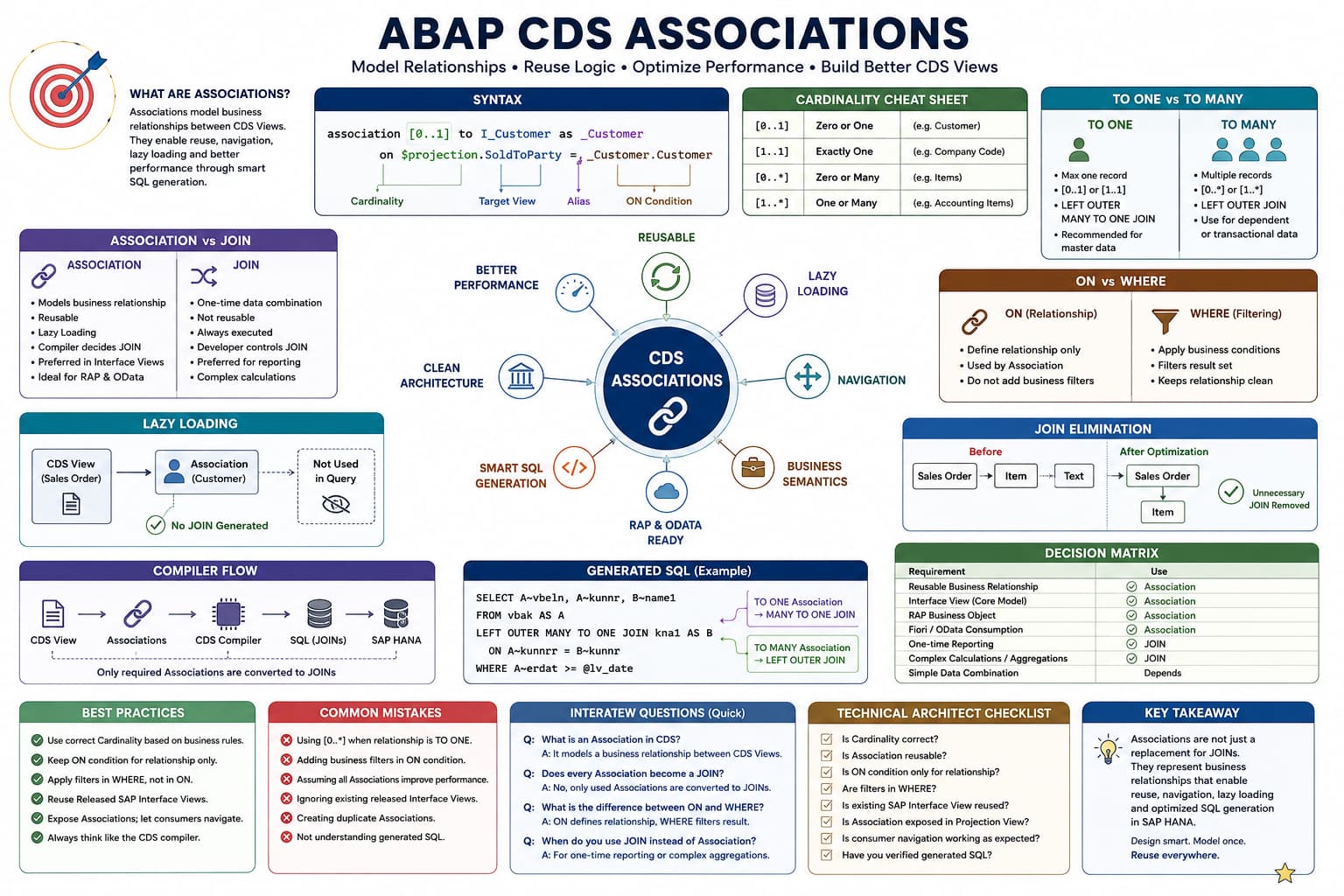
Association Masterclass
Lesson 8 of 15 – ON Condition vs WHERE Clause
This lesson answers one of the most common interview questions and one of the biggest causes of performance issues in custom CDS Views.
Should a condition be placed inside the ON clause or in the WHERE clause?
Although both filter data, they are executed at different stages of query processing and therefore can produce different SQL, performance characteristics and even different business results.
Learning Objectives
- Understand the purpose of the ON condition.
- Understand the purpose of the WHERE clause.
- Learn how the CDS compiler treats both differently.
- Understand filter pushdown.
- Prepare for TO MANY restrictions in Part 2.
Introduction
Developers often think that these two statements are interchangeable.
association [0..1] to I_Customer as _Customer

on $projection.SoldToParty = _Customer.Customerwhere SalesOrganization = '1010'They are not solving the same problem.
The ON condition defines the relationship between two business objects.
The WHERE clause filters the final result set after those business relationships have been evaluated.
Architect Perspective
Think of the ON condition as answering one question:"How are these two business objects related?"
Think of the WHERE clause as answering another question:
"Which business records should finally be returned?"
Understanding the ON Condition
Every Association requires an ON condition.
It defines the relationship between the source and target business objects.
association [0..1] to I_Customer as _Customer

on

$projection.SoldToParty

=

_Customer.Customer
The compiler stores this relationship as metadata.
Whenever a consumer navigates the Association, this condition becomes part of the generated JOIN.
Understanding the WHERE Clause
The WHERE clause is fundamentally different.
where SalesOrganization = '1010'This condition has nothing to do with the relationship between business objects.
It simply filters the records that should appear in the final result.
A Real Business Example
Consider a Sales Order and Customer relationship.
association [0..1] to I_Customer as _Customer

on

$projection.SoldToParty

=

_Customer.Customer
This relationship should never change.
Whether you display one Sales Order or one million Sales Orders, every Sales Order is still related to its Sold-To Customer using the same business rule.
Now suppose the business asks:
Show only Sales Orders created today.
That is not a relationship.
That is simply a filter.
where CreationDate = $session.system_dateCompiler View of ON vs WHERE
The CDS compiler processes these clauses at different stages.
| ON Condition | WHERE Clause |
|---|---|
| Defines business relationship. | Filters final result. |
| Becomes JOIN condition. | Becomes SQL WHERE. |
| Part of Association metadata. | Part of query execution. |
INSIDE THE CDS COMPILER
Relationship vs Filtering
💭 Compiler Thought Process
The compiler first builds relationships between business objects and only afterwards applies result filtering.
Compiler Decision Flow
Read the root CDS View.
Read every Association.
Store every ON condition.
Generate JOINs.
Apply WHERE conditions.
Return the filtered result.
✅ Final Compiler Decision
ON conditions participate in relationship generation. WHERE clauses filter the generated result set.
⚡ SQL Optimization Insight
Moving a condition from ON to WHERE can completely change both the generated SQL and the returned business data.
The Same Condition in ON and WHERE Produces Different Results
At first glance, the following two CDS Views appear to do the same thing.
They don't.
The location of the condition completely changes the semantics of the query.
association [0..1] to I_Customer as _Customer

on  $projection.SoldToParty = _Customer.Customer
and _Customer.Country = 'IN'
Here the country condition becomes part of the JOIN itself.
Every Sales Order is still returned, but Customer data is populated only when the matching Customer belongs to India.
where _Customer.Country = 'IN'Here the relationship is evaluated first and then the entire result set is filtered.
Sales Orders without an Indian Customer disappear completely.
How the Generated SQL Changes
Consider a LEFT OUTER JOIN generated by the compiler.
LEFT OUTER JOIN I_CUSTOMER

ON

SALESORDER.SOLDTOPARTY = CUSTOMER.CUSTOMER

AND CUSTOMER.COUNTRY = 'IN'
Every Sales Order still participates in the result because the filter belongs to the JOIN condition.
LEFT OUTER JOIN I_CUSTOMER

ON

SALESORDER.SOLDTOPARTY = CUSTOMER.CUSTOMER

WHERE CUSTOMER.COUNTRY = 'IN'
This WHERE clause removes every row where the joined Customer is NULL.
In practice, the LEFT OUTER JOIN now behaves almost like an INNER JOIN.
Why TO MANY Associations Cannot Be Used in WHERE
This is one of the most misunderstood CDS restrictions.
association [0..*] to I_SalesDocumentItem as _Item

on $projection.SalesDocument = _Item.SalesDocument
Developers often try to write:
where _Item.Material = 'TG11'The CDS compiler rejects this because the Association may return multiple matching records.
Understanding the Ambiguity
Imagine the following Sales Order.
Sales Order 500000001

↓

Item 10 → Material ABC

↓

Item 20 → Material XYZ

↓

Item 30 → Material DEF
Now ask yourself one simple question.
What exactly does this condition mean?
where _Item.Material = 'ABC'Should the Sales Order be returned because one Item matches?
Should only Item 10 remain?
Should Items 20 and 30 disappear?
The compiler cannot answer these questions deterministically.
Rather than guessing, it rejects the statement completely.
INSIDE THE CDS COMPILER
TO MANY in WHERE
💭 Compiler Thought Process
The Association may return multiple target records. A scalar WHERE condition requires exactly one value.
Compiler Decision Flow
Read the Association.
Determine Cardinality (TO MANY).
Evaluate the WHERE clause.
Detect multiple possible target records.
Unable to determine a single comparison value.
Reject the statement.
✅ Final Compiler Decision
Compilation error because the semantics are ambiguous.
⚡ SQL Optimization Insight
The restriction exists to protect correctness, not because of a technical limitation.
What Should You Do Instead?
If you need to filter Item data, there are better design options.
| Requirement | Recommended Solution |
|---|---|
| Filter Sales Order Items | Build the CDS on I_SalesDocumentItem instead of the header. |
| Filter Customer | TO ONE Associations can safely be filtered. |
| Complex filtering | Consider explicit JOINs or redesign the data model. |
Real Project Example: Sales Order Search Application
A common mistake is trying to filter the Header CDS View using:
where _Item.Material = 'TG11'This produces deterministic results and scales much better for large datasets.
Architect Perspective
Technical Architect InsightAsk yourself one question before writing every condition.
Am I defining a relationship,
or filtering business data?
Relationship rules belong in the ON condition.
Business filters belong in the WHERE clause.
Mixing these responsibilities is one of the most common causes of incorrect CDS models.
💡 SAP Best Practice
Use the WHERE clause only to restrict the final business result.
If filtering requires navigating a TO MANY Association, reconsider the root data source or redesign the CDS View instead of trying to force the condition into WHERE.
❌ Common Mistakes
- Using ON conditions to implement business filters.
- Using WHERE conditions to define relationships.
- Trying to filter TO MANY Associations directly in WHERE.
- Assuming ON and WHERE are interchangeable.
Why can the same condition produce different results when placed in ON and WHERE?
Answer: An ON condition becomes part of the JOIN relationship, whereas a WHERE clause filters rows after the JOIN has been evaluated. This can change both the generated SQL and the final result set.
Why are TO MANY Associations restricted in WHERE clauses?
Answer: Because a TO MANY Association may return multiple target records. The compiler cannot derive a single deterministic value for a scalar comparison, so it rejects the statement to prevent ambiguous query semantics.
💡 Key Takeaway
The ON condition and WHERE clause solve different problems.
The ON condition defines relationships between business objects, whereas the WHERE clause filters the final business result.
Understanding this distinction explains why conditions placed in different locations can produce different SQL, different performance characteristics and even different business results.
In the next lesson, we'll explore Multiple and Nested Associations and see how the CDS compiler navigates complex business relationship graphs.