Core Data Services (CDS)?
Core Data Services (CDS) are SAP's strategic data modeling technology used to create semantically rich business data models on top of database tables.
SAP introduced ABAP CDS with ABAP Release 7.40 SP05 as part of its transition toward SAP HANA and modern application development. Today, CDS forms the foundation of SAP S/4HANA, SAP Fiori applications, OData services, analytical reporting, and the ABAP RESTful Application Programming Model (RAP).
Unlike traditional database views that primarily focus on retrieving data, CDS provides a complete framework for modeling business entities, defining relationships, implementing calculations, controlling access, and enriching data with metadata.
SAP defines CDS as an infrastructure used to create business-oriented data models that are easier to understand, consume, and reuse across applications.
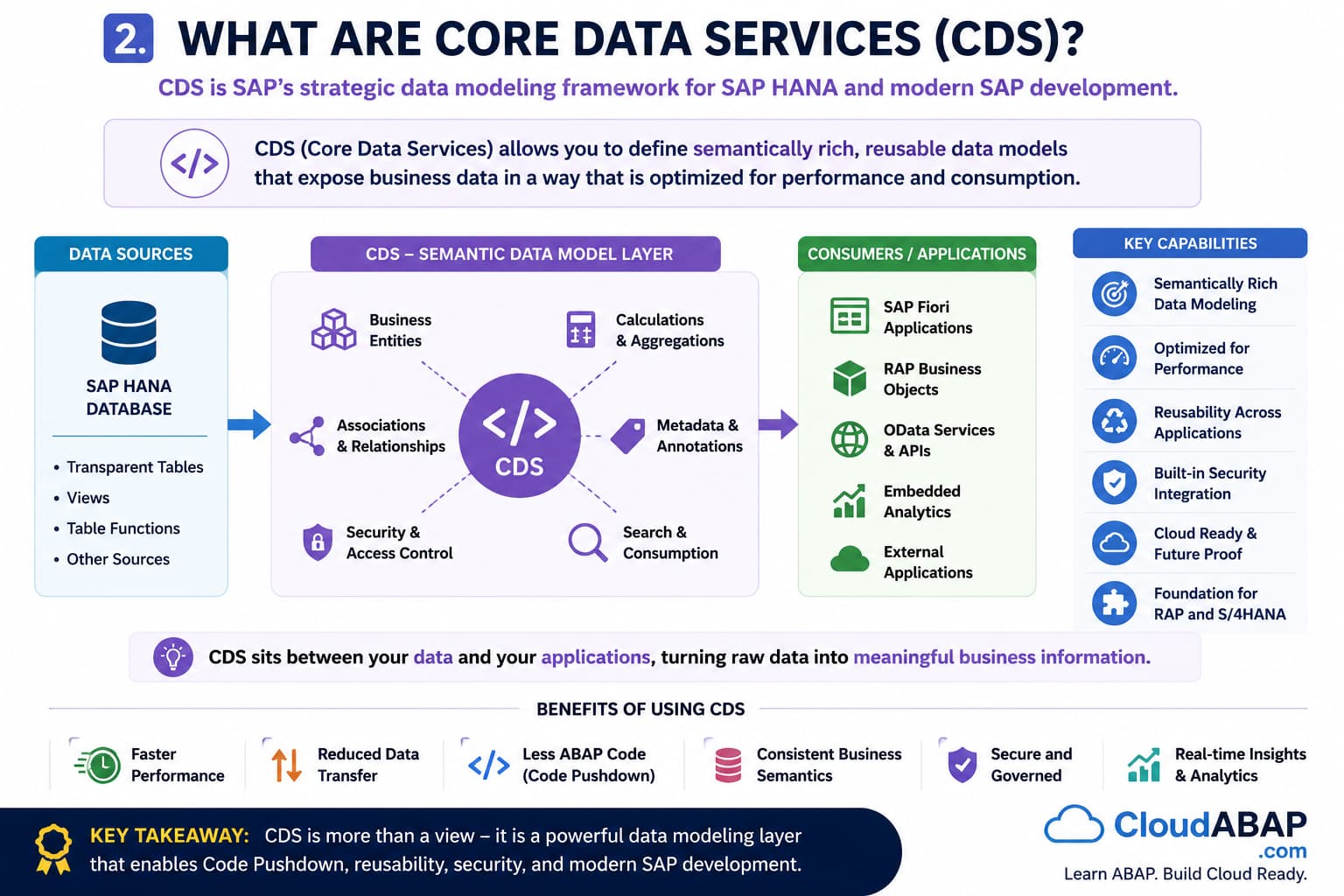
Business-Oriented Data Modeling
Instead of exposing technical database tables directly to applications, CDS introduces a semantic layer that represents real business concepts such as:
- Sales Orders
- Purchase Orders
- Business Partners
- Products
- Suppliers
- Accounting Documents
This abstraction allows developers to work with business entities rather than low-level database structures.
For example, instead of joining multiple sales-related tables every time an application needs order information, a CDS View Entity can expose a complete Sales Order business object that already contains all required fields, relationships, and business semantics.
As a result, CDS improves:
- Readability
- Reusability
- Maintainability
- Performance
- Development Productivity
This is one of the key reasons why CDS has become the central data modeling technology in SAP S/4HANA.
Real Project Example: Purchase Register Application
Imagine a Purchase Register application.
Without CDS, every report, API, and Fiori application would need to repeatedly perform joins across multiple purchasing and accounting tables to retrieve supplier details, invoice amounts, tax information, and posting data.
With CDS, these relationships are modeled once inside a reusable CDS View Entity.
Any application consuming that CDS entity automatically gains access to the same standardized business view of the data.
This eliminates duplicate development efforts and ensures consistency across reports, APIs, and applications.
Why CDS Is Important for RAP
In RAP, CDS is not optional.
Every RAP business object starts with a CDS data model.
The CDS entities define:
- Business Data Structure
- Relationships Between Entities
- Exposed Fields
- Search Capabilities
- UI Metadata
- Authorization Behavior
Behavior Definitions then add transactional capabilities such as Create, Update, Delete, Actions, Determinations, and Validations.
CDS provides the business data model, while RAP provides the business behavior.
Without CDS, RAP cannot exist.
This is why mastering CDS is the first and most important step toward becoming a successful RAP developer.
Architect Perspective
CDS is not just a replacement for database views. It is SAP's strategic semantic data modeling layer that sits between database tables and business applications.Almost every modern SAP technology including RAP, Fiori Elements, OData Services, Embedded Analytics, and SAP APIs relies on CDS.
Why did SAP introduce CDS when database views already existed?
Answer: Traditional database views only expose data. CDS introduces a semantic business layer that supports associations, annotations, security, calculations, analytics, OData consumption, and RAP development.
What is the biggest advantage of CDS over classical ABAP reporting?
Answer: CDS enables Code Pushdown by executing joins, calculations, filters and aggregations directly in SAP HANA instead of the ABAP application server.
Why is CDS considered a business-oriented data model?
Answer: CDS models business entities such as Sales Orders, Products, Suppliers and Business Partners rather than exposing raw database tables and technical structures.