Data Compression in SAP HANA: An Introduction
One of the biggest challenges of In-Memory Computing is memory consumption.
If every business transaction had to be stored uncompressed in RAM, hardware costs would become extremely expensive.
SAP HANA solves this challenge through advanced data compression techniques.
By combining Column Store architecture with intelligent compression algorithms, SAP HANA significantly reduces the amount of memory required to store enterprise data while simultaneously improving query performance.
This innovation makes large-scale In-Memory Computing economically feasible.
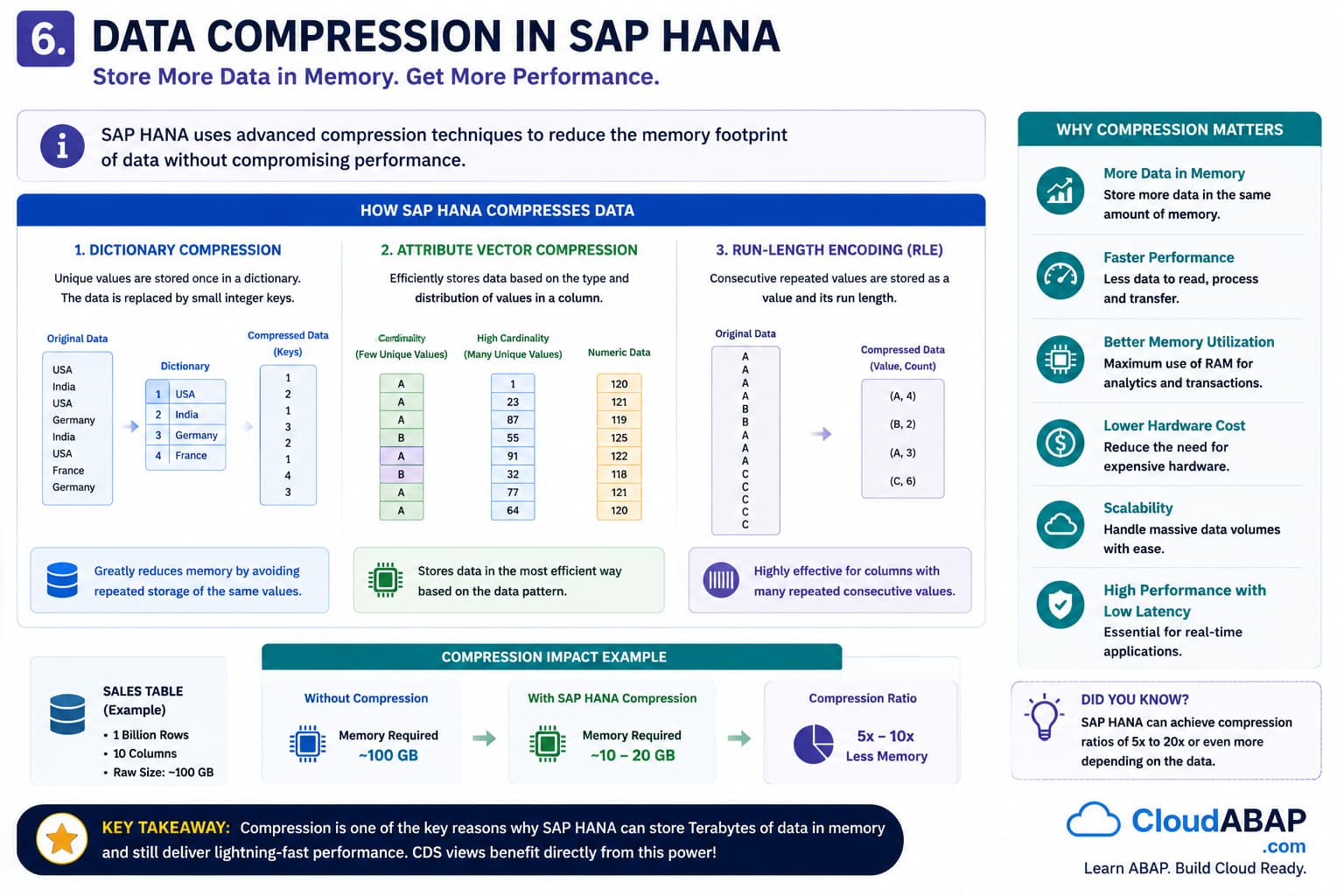
Why Compression Matters in SAP HANA
Modern SAP systems process enormous amounts of business data.
Examples include:
- Sales Orders
- Purchase Orders
- Material Documents
- Journal Entries
- Billing Documents
- Inventory Transactions
Many business fields contain repeating values.
For example, thousands of records may contain the same Company Code, Tax Code, Plant, Currency, or Purchasing Organization.
Storing the same value repeatedly consumes unnecessary memory.
SAP HANA eliminates this redundancy through compression techniques.
Dictionary Encoding: The Foundation of SAP HANA Compression
One of the most common compression techniques used by SAP HANA is Dictionary Encoding.
Instead of storing the same value repeatedly, SAP HANA stores the value once in a dictionary and replaces it with a small numeric reference.
Original Data
| Department |
|---|
| Finance |
| Finance |
| Sales |
| Finance |
| Sales |
| Finance |
Dictionary
| Code | Value |
|---|---|
| 1 | Finance |
| 2 | Sales |
Stored Data
| Encoded Values |
|---|
| 1, 1, 2, 1, 2, 1 |
Instead of storing long text values multiple times, SAP HANA stores compact numeric references.
This dramatically reduces memory consumption.
Why Compression Improves Performance
Many developers assume compression only saves storage space.
In reality, compression also improves performance.
Because compressed data occupies less memory:
- More data fits into RAM
- Less data must be scanned
- CPU cache utilization improves
- Aggregations execute faster
- Query response times decrease
Compression therefore contributes directly to SAP HANA's overall performance.
How Compression Works with Column Store
Compression becomes even more effective because of Column Store architecture.
Since identical values are stored together within a column, SAP HANA can achieve extremely high compression ratios.
This is much harder to achieve in traditional Row Store databases where values from different columns are mixed together.
Column Store and Compression therefore work hand-in-hand.
Real Project Example: Purchase Register with 50 Million Records
Consider a Purchase Register containing 50 million invoice records.
Many columns contain repeated values such as:
- Company Codes
- Plants
- Tax Codes
- Currencies
- Purchasing Organizations
- Document Types
Instead of storing the same values millions of times, SAP HANA compresses them using dictionary-based techniques.
The result is:
- Lower memory consumption
- Faster query execution
- Reduced hardware requirements
- Better scalability
This allows organizations to process very large datasets while maintaining high performance.
Compression and CDS Views
Compression is one of the hidden reasons CDS Views perform efficiently.
When CDS executes:
- Aggregations
- Calculations
- Filtering
- Grouping
- Analytics
SAP HANA processes compressed columnar data directly.
Because less data must be scanned and moved through memory, CDS queries benefit automatically from SAP HANA's compression engine.
Developers do not need to write special code to leverage this optimization.
The database handles it automatically.
Why Compression Was Critical for SAP HANA
Without compression, storing large enterprise datasets entirely in memory would be prohibitively expensive.
Compression enables SAP HANA to:
- Store more data in RAM
- Process larger datasets
- Reduce infrastructure costs
- Deliver real-time performance
This is one of the foundational technologies that made SAP HANA commercially viable.
Benefits of SAP HANA Compression
| Benefit | Impact |
|---|---|
| Lower Memory Usage | Stores more data in RAM |
| Faster Queries | Less data must be scanned |
| Better CPU Utilization | Improved cache efficiency |
| Lower Infrastructure Cost | Reduced hardware requirements |
| Higher Scalability | Supports massive enterprise datasets |
💡 Key Takeaway
SAP HANA compression is not merely a storage optimization technique. It is a performance technology.
By combining Column Store architecture with intelligent compression algorithms, SAP HANA reduces memory consumption while simultaneously accelerating query execution.
This allows CDS Views and SAP applications to process massive volumes of business data efficiently in real time.