Traditional Databases to SAP HANA In-Memory Computing
This tutorial covers the evolution from traditional databases to SAP HANA in-memory computing.
Understanding CDS requires understanding SAP HANA.
While CDS provides the data modeling layer, SAP HANA provides the processing engine that makes Code Pushdown possible.
Before SAP HANA, most enterprise databases stored data primarily on physical disks. Whenever an application requested information, the database had to read data from disk, load it into memory, process the request, and then return the result.
Although this architecture served enterprise systems for decades, disk access gradually became one of the largest performance bottlenecks as data volumes increased.
As organizations generated more transactional and analytical data, traditional databases struggled to provide real-time processing and reporting capabilities.
SAP needed a new database architecture capable of processing large volumes of data in real time.
This led to the introduction of SAP HANA.
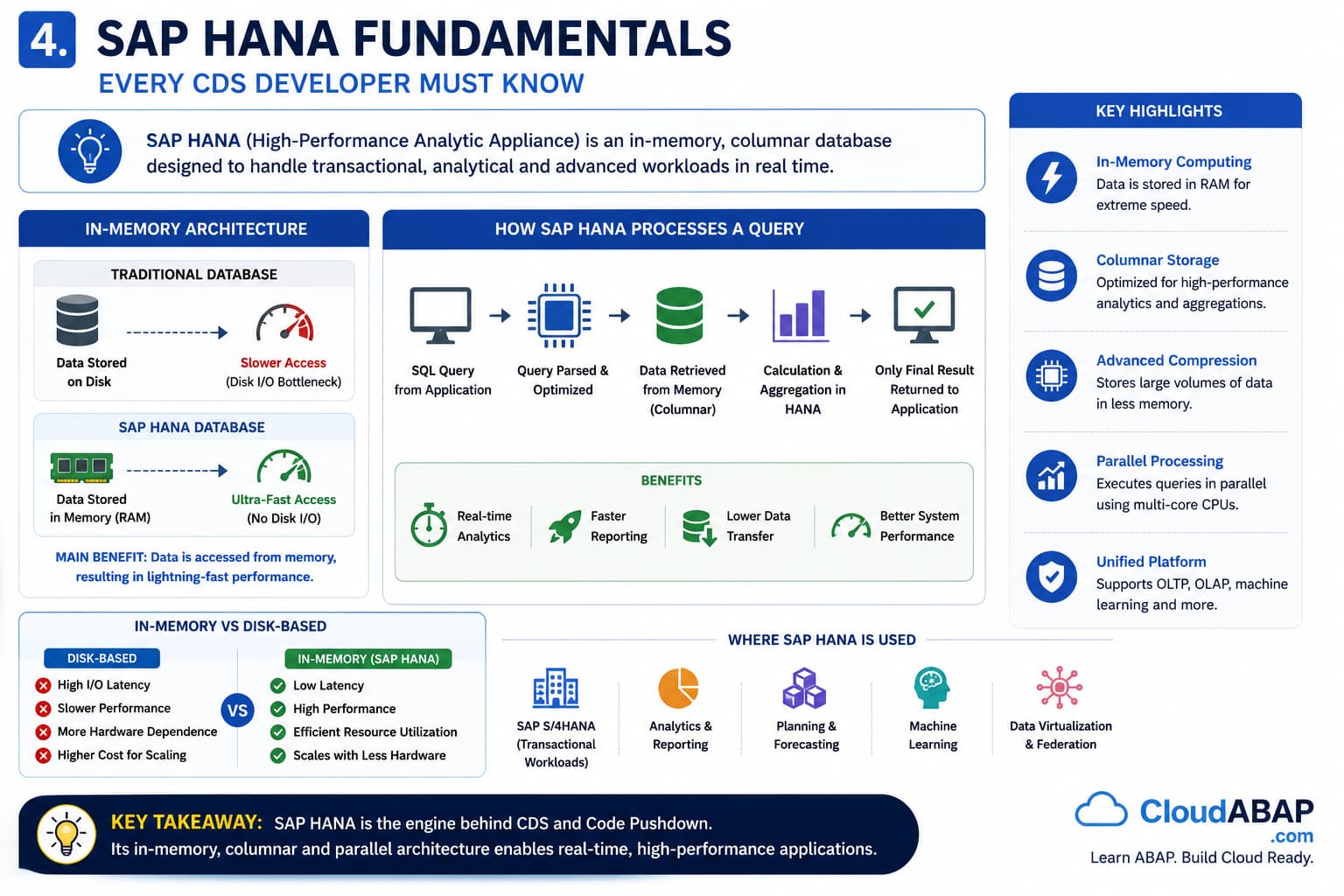
What Is SAP HANA?
SAP HANA stands for:
High-Performance Analytic Appliance
It is an in-memory relational database designed to process transactional and analytical workloads on a single platform.
Unlike traditional databases that rely heavily on disk-based storage, SAP HANA stores active business data directly in main memory (RAM).
Because memory access is dramatically faster than disk access, data can be processed much more efficiently.
This allows applications to perform complex calculations, aggregations, searches, and analytics in real time.
Traditional Database Architecture
In a traditional system, data processing follows a multi-step path:
- Data is stored on disk.
- Required data is loaded into memory.
- The CPU processes the request.
- Results are returned to the application.
Every database request involves disk access, which introduces latency.
As datasets grow larger, these delays become increasingly noticeable.
This is one of the main reasons why older reporting applications often require batch jobs, aggregates, indexes, or pre-calculated totals.
SAP HANA In-Memory Architecture
SAP HANA fundamentally changes this architecture.
Instead of repeatedly reading data from disk, active business data resides directly in memory.
The processing flow becomes:
- Data is stored in memory.
- The CPU processes the request directly.
- Results are returned immediately.
Because expensive disk reads are minimized, applications can execute complex calculations significantly faster.
This is the foundation that enables modern SAP applications to provide near real-time reporting and analytics.
Why In-Memory Computing Matters for CDS
The true power of CDS comes from its integration with SAP HANA.
CDS allows developers to define calculations, associations, aggregations, filters, and business logic at the data model level.
SAP HANA then executes those operations directly within the database.
Instead of transferring millions of records to the application server for processing, only the final result set is returned.
This dramatically reduces:
- Data transfer volume
- Network overhead
- Application server workload
- Memory consumption
while simultaneously improving performance and scalability.
Real Project Example: Financial Reporting Application
Consider a financial reporting application that needs to calculate monthly revenue across millions of accounting documents.
In a Traditional Architecture
- Large datasets are transferred to the application server.
- Revenue calculations are executed in ABAP.
- Aggregations are performed using loops and internal tables.
- The final result is generated after significant processing.
In SAP HANA
- Aggregations execute directly in the database.
- Revenue calculations are performed by the database engine.
- Only summarized results are returned.
The application processes far less data while delivering significantly faster response times.
Why SAP HANA Changed SAP Development
The introduction of SAP HANA was not merely a database upgrade.
It fundamentally changed how SAP applications are designed and developed.
Technologies such as:
- CDS
- RAP
- Embedded Analytics
- Fiori Elements
- OData Services
all rely heavily on SAP HANA's in-memory architecture and processing capabilities.
Without SAP HANA, concepts such as Code Pushdown and modern CDS-based application development would not be possible.
Architect Perspective
SAP HANA is not simply a faster database. It represents a completely different architectural approach where data processing occurs as close as possible to the data itself.Understanding SAP HANA's in-memory architecture is essential for understanding CDS, RAP, Embedded Analytics, and the Code Pushdown paradigm used throughout SAP S/4HANA.
Interview Questions
What is SAP HANA and what does HANA stand for?
Answer: SAP HANA stands for High-Performance Analytic Appliance. It is an in-memory relational database that processes transactional and analytical workloads on a single platform.
Why is SAP HANA significantly faster than traditional databases?
Answer: SAP HANA stores active business data in memory rather than repeatedly reading from disk. This eliminates expensive disk I/O operations and allows calculations to be executed much faster.
Why is SAP HANA important for CDS and RAP?
Answer: CDS and RAP rely on SAP HANA's ability to execute calculations, aggregations, joins, and business logic directly within the database. This enables the Code Pushdown paradigm and provides the scalability required by modern SAP applications.
💡 Key Takeaway
SAP HANA transformed enterprise application development by moving data processing closer to the database.
Its in-memory architecture provides the performance foundation that allows CDS to implement the Code Pushdown paradigm and serve as the primary data modeling technology in SAP S/4HANA and RAP.