Why Parallel Processing Matters
Modern enterprise systems generate enormous volumes of business data.
Even with In-Memory Computing, Column Store architecture, and advanced compression techniques, processing billions of records sequentially would still be time-consuming.
SAP HANA addresses this challenge through Parallel Processing.
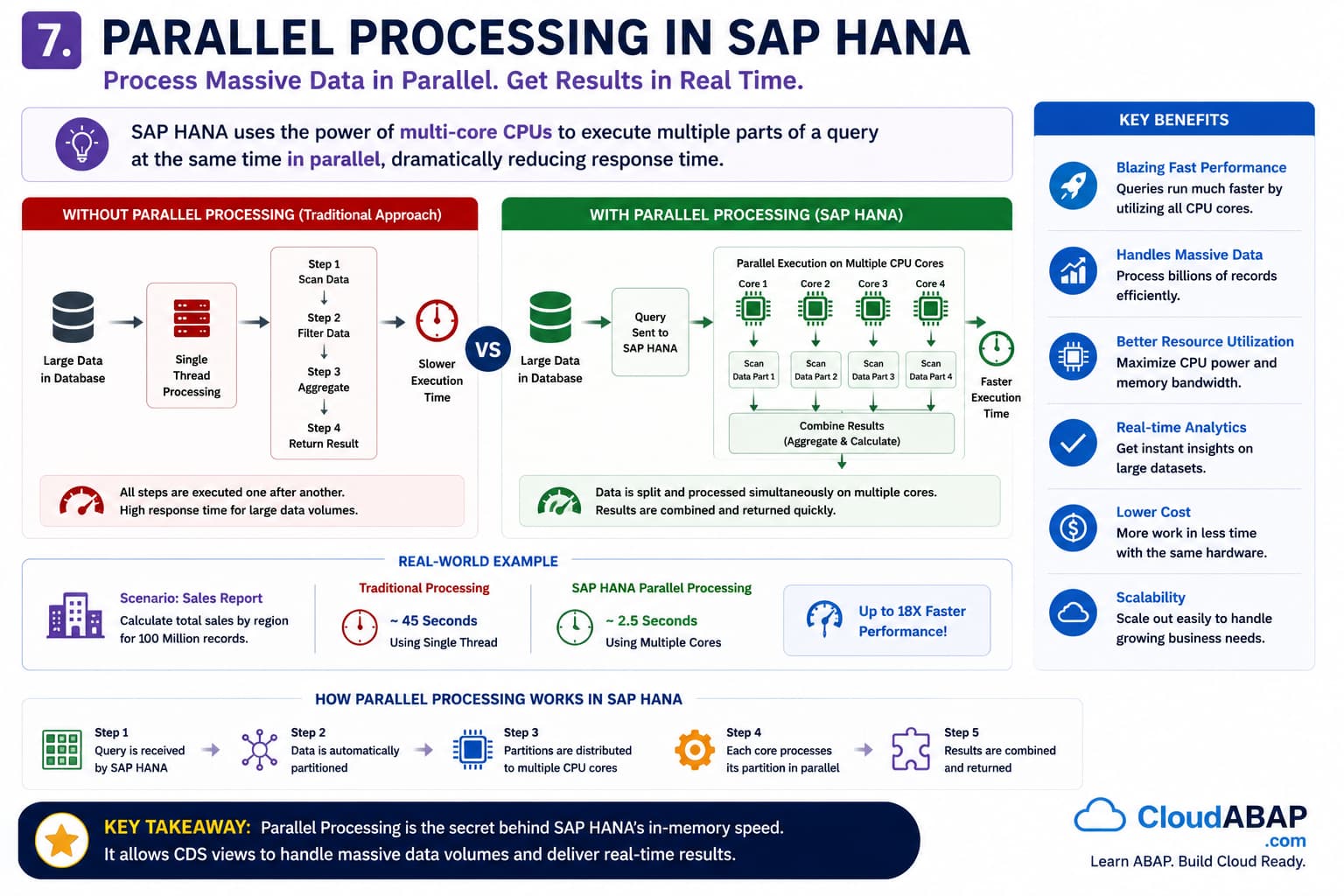
Instead of executing database operations on a single CPU core, SAP HANA distributes workloads across multiple processor cores simultaneously.
This allows large datasets to be processed significantly faster and is one of the key reasons SAP HANA can deliver near real-time analytics and reporting.
Traditional Sequential Processing
In traditional database architectures, many operations are executed sequentially.
This means:
- One task is processed.
- The next task starts only after the previous task finishes.
- The workload follows a single execution path.
As data volumes increase, sequential processing becomes a performance bottleneck because only a small portion of available hardware resources is utilized.
A report calculating revenue across millions of records may need to scan the entire dataset before producing a result.
Even if the server contains multiple CPU cores, traditional processing models often cannot fully utilize them.
How Parallel Processing Works
SAP HANA was designed to take advantage of modern multi-core processors.
Instead of processing a large dataset as a single task, SAP HANA divides the workload into smaller tasks and distributes them across multiple CPU cores.
Each core processes a portion of the data independently.
The partial results are then combined to produce the final output.
This approach significantly reduces overall execution time.
Sequential Processing vs Parallel Processing
| Characteristic | Sequential Processing | Parallel Processing |
|---|---|---|
| CPU Usage | Single Core | Multiple Cores |
| Execution Model | One Task at a Time | Multiple Tasks Simultaneously |
| Performance | Slower for Large Datasets | Much Faster |
| Scalability | Limited | High |
| Analytics | Less Efficient | Optimized |
Why Column Store Enables Parallel Processing
Column Store and Parallel Processing work exceptionally well together.
Because each column is stored independently, SAP HANA can process multiple columns simultaneously.
Consider a query calculating:
- Total Sales Value
- Total Tax Amount
- Total Discount Amount
Instead of processing these calculations one after another, SAP HANA can distribute them across multiple CPU cores and execute them in parallel.
This dramatically improves performance for analytical workloads.
Real Project Example: Purchase Register with 100 Million Records
Imagine a Purchase Register containing 100 million invoice records.
A finance user requests:
- Total Taxable Value
- Total GST Amount
- Total Invoice Value
- Monthly Aggregations
- Vendor-Wise Summaries
Traditional Architecture
- Records are processed sequentially.
- Calculations execute one after another.
- Report generation may take several minutes.
SAP HANA
- Data is divided into smaller partitions.
- Multiple CPU cores process different portions simultaneously.
- Aggregations execute in parallel.
- Results are merged and returned.
The same report can often be generated in a fraction of the time.
Why Parallel Processing Matters for CDS
One of the biggest advantages of CDS is that developers do not need to manually implement parallelization logic.
When a CDS View performs:
- Aggregations
- Grouping
- Calculations
- Filtering
- Analytics
SAP HANA automatically determines how the workload should be distributed across available CPU resources.
The database engine handles optimization internally.
Developers can focus on business logic while SAP HANA handles execution efficiency.
Parallel Processing and Code Pushdown
The Code Pushdown paradigm becomes even more powerful when combined with Parallel Processing.
CDS pushes calculations to SAP HANA.
SAP HANA then executes those calculations across multiple CPU cores simultaneously.
This combination allows enterprise applications to process massive datasets while maintaining fast response times.
Without Parallel Processing, many advanced analytical scenarios would not be practical at enterprise scale.
Why Parallel Processing Changed SAP Development
Traditional application development often required:
- Batch processing
- Aggregate tables
- Pre-calculated totals
- Complex performance tuning
SAP HANA's parallel execution engine eliminates much of this complexity.
Developers can now perform real-time calculations directly on transactional data without creating separate reporting structures.
This is one of the reasons why SAP S/4HANA simplified many traditional SAP data models.
Bringing It All Together
SAP HANA's performance is not the result of a single technology.
It is the combination of:
- In-Memory Computing
- Column Store Architecture
- Data Compression
- Parallel Processing
These technologies work together to create a platform capable of executing CDS-based applications efficiently at enterprise scale.
Architect Perspective
SAP HANA's performance is not the result of a single innovation.In-Memory Computing, Column Store Architecture, Data Compression, and Parallel Processing work together to create a platform capable of processing enterprise-scale datasets efficiently.
CDS benefits automatically from this architecture because calculations are executed directly inside SAP HANA rather than on the ABAP application server.
Interview Questions
What is Parallel Processing in SAP HANA?
Answer: Parallel Processing allows SAP HANA to distribute workloads across multiple CPU cores simultaneously instead of processing everything on a single core.
Why does Column Store work well with Parallel Processing?
Answer: Because columns are stored independently, SAP HANA can process different columns and partitions simultaneously across multiple CPU cores.
How does Parallel Processing support CDS performance?
Answer: When CDS executes aggregations, calculations, filtering, and analytics, SAP HANA automatically distributes the workload across available CPU resources, enabling real-time processing of large datasets.
💡 Key Takeaway
Parallel Processing allows SAP HANA to utilize multiple CPU cores simultaneously, dramatically reducing query execution times.
When CDS Views perform calculations, aggregations, and analytics, SAP HANA automatically distributes the workload across available processors, enabling real-time performance even for very large datasets.